Blueprint Alliance Is an Important Step. But Governance Doesn't Stop at the Blueprint.


The launch of the Blueprint Alliance marks an important moment in enterprise AI governance. A coalition of major technology vendors has aligned around common principles for governing AI agents at scale, giving the industry a shared language for a rapidly changing risk landscape.
The Alliance frames agent governance around four practical questions:
Where are my agents?
What can they do?
What are they doing?
How do I respond?
Its six core principles include
agent identity,
least-privilege access,
delegation traceability,
runtime monitoring,
containment,
and adaptive governance.
This is exactly the conversation the industry needs. But defining good governance is only the beginning. The harder challenge is operationalising governance at runtime—and doing so when an enterprise moves from dozens of agents to thousands.
The Blueprint Solves the Governance Framework
Blueprint brings together concepts that have historically been described separately:
AI security,
agent security,
agent trust,
agent management,
runtime protection,
and AI observability.
Most importantly, it recognises that agents must be treated as first-class digital identities throughout their lifecycle.
But frameworks alone do not provide governance. Frameworks provide intent. Runtime systems provide enforcement.
The Missing Layer: Runtime Governance
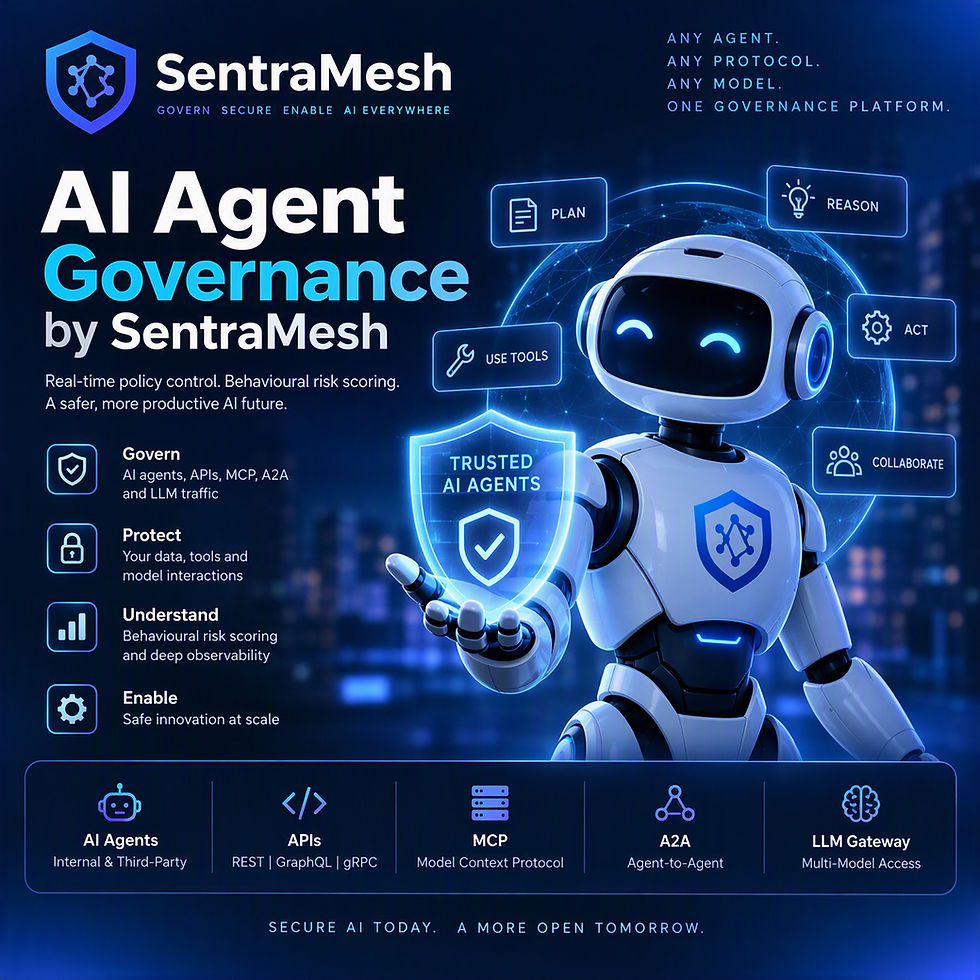
Questions such as ‘What are agents doing?’ and ‘How do I respond?’ are fundamentally runtime questions. This is where SentraMesh focuses today, combining identity-aware enforcement, policy-based authorisation, runtime telemetry, risk scoring, behaviour analytics, MCP governance, A2A governance, LLM gateway governance, and real-time policy enforcement.
In simple terms: Blueprint defines governance. SentraMesh executes governance.
The Industry’s Biggest Blind Spot
The largest problem may not be enforcement. It may be discovery. Many governance architectures begin with a hidden assumption:
register the agent,
apply governance,
and monitor it.
Enterprise history suggests that assumption will fail.
Shadow IT, shadow SaaS, and shadow cloud emerged because systems were adopted outside formal registration processes. AI agents may follow the same path. They may be called copilots, assistants, bots, automations, workflows, or integrations rather than agents.
The result is a new class of enterprise risk: shadow AI agents. Governance cannot begin if organisations do not know what exists.
Beyond Agent Registries
The industry is already moving beyond simple inventories. Emerging approaches connect AI agents, models, datasets, prompts, MCP servers, ownership, relationships, and business context. This raises an important question: are agent registries already the wrong abstraction?
Perhaps enterprises need an Agent CMDB — a living operational view of the AI systems their business depends on.
The Emergence of the Agent CMDB
Several standards are emerging independently, each solving part of the problem:
A2A Agent Cards: agent identity and capabilities.
MCP: tool discovery and access.
CycloneDX ML-BOM: AI supply-chain transparency.
Blueprint Alliance: governance principles.
An enterprise must be able to understand who owns an agent, what business service depends on it, which models and MCP tools it uses, what data it can see, which agents it can delegate to, where it is deployed, what its runtime risk is, and whether it can be stopped.
These are not merely security questions. They are configuration-management questions.
Our Vision: Operational AI Governance
SentraMesh is extending governance beyond identities and policies toward an Operational AI CMDB. This model combines agent identity, tool inventories, supply-chain transparency, runtime discovery, risk analytics, and policy enforcement into a living digital representation of an AI system.
Three Gaps to Fill
1. Runtime-Native Discovery
The greater challenge is discovering unregistered agents, MCP servers, LLM workflows, delegation chains, and shadow AI systems before they become governance problems.
2. Agent Relationship Mapping
Future enterprises will operate agent ecosystems rather than isolated agents. Understanding relationships such as Human → Supervisor Agent → Research Agent → MCP Server → Model will be critical for governance, audit, and risk management.
3. Governance Enforcement
Discovery and inventory are not enough. Governance requires the ability to allow, deny, restrict, isolate, and contain activity at runtime. That remains a core design principle of SentraMesh.
Looking Ahead
The Blueprint Alliance has established a common governance vocabulary and highlighted the need for consistent approaches to managing AI agents at scale. The next challenge is operationalising that vision.
Governance will evolve beyond identity, inventory, and registration. The future belongs to platforms that combine discovery, identity, ownership, supply-chain transparency, runtime behaviour, risk, relationships, and enforcement in a single operational model.
Blueprint has provided the map. The next phase is building the runtime systems that can actually navigate it.


Comments