Why SentraMesh Belongs in the AI Agent Management Platform Conversation

Updated: 19 hours ago

Gartner's latest Magic Quadrant for AI Agent Management Platforms (AMPs) signals a major shift in how enterprises think about AI governance. The conversation is no longer centred on models alone.
It is increasingly focused on managing, securing and governing autonomous agents operating across complex enterprise environments.
For organisations investing in agentic AI, this raises an important question: Who governs the behaviour of AI agents once they are in production?
At SentraMesh, we believe the answer requires a fundamentally different approach from traditional AI governance platforms.
The Market Is Moving Beyond AI Governance
The first generation of AI governance platforms focused on responsible AI policies, model governance, compliance reporting, risk assessments, documentation and audit trails. These capabilities remain essential.
However, autonomous AI introduces an entirely new set of challenges. Modern AI agents can:
Access enterprise systems.
Call APIs.
Execute workflows.
Share information with other agents.
Make decisions autonomously.
Interact through protocols such as Model Context Protocol (MCP).
The governance challenge is no longer simply, ‘Was this model approved?’ It becomes, ‘What is this agent doing right now?’
The Emergence of AI Agent Management Platforms
Gartner's AMP category reflects this evolution. Enterprises require centralised platforms capable of providing agent governance, security controls, operational visibility, behavioural oversight, runtime management and cross-platform policy enforcement.
This shift moves governance from a static process into a dynamic operational capability. Governance must move from documents and dashboards into the execution path itself. That is precisely where SentraMesh is positioned.
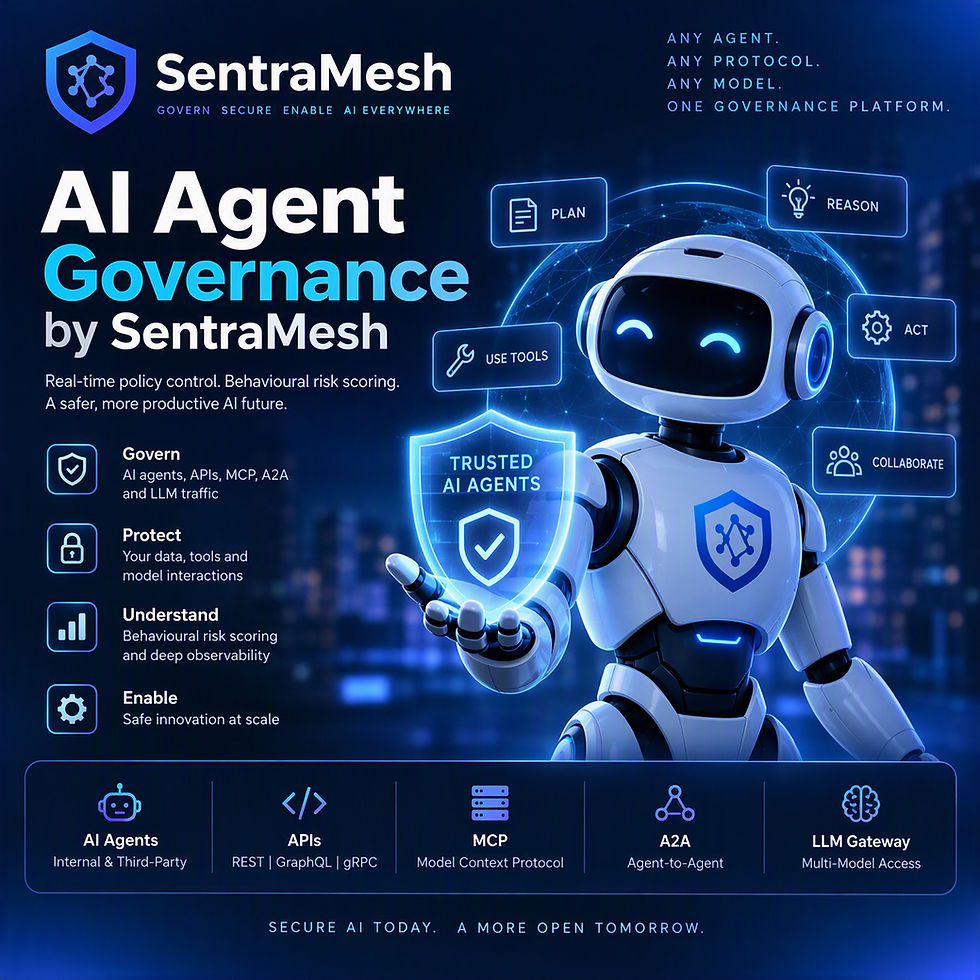
SentraMesh: The Runtime Governance Control Plane
SentraMesh was designed around a simple premise: AI governance should be enforced at runtime, not merely evaluated after the fact.
Rather than acting as a repository for policies, SentraMesh acts as a control plane for agentic AI systems.
Real-Time Behavioural Governance
SentraMesh continuously observes agent activity across distributed environments, providing visibility into agent actions, tool usage, decision paths, agent-to-agent interactions and MCP transaction flows.
Instead of simply recording events, SentraMesh enables organisations to understand how autonomous systems are behaving in production.
Inline Policy Enforcement
Many governance products can identify policy violations after they occur. SentraMesh is built to prevent them. By integrating directly into the AI data plane, policies can be enforced before actions are executed.
This allows organisations to block unauthorised operations, prevent policy violations, restrict sensitive data access and apply governance controls consistently across environments.
Behavioural Risk Scoring
SentraMesh continuously evaluates agent decision patterns, operational anomalies, trust boundaries and escalation conditions.
The result is a governance framework that understands behaviour rather than merely configuration.
How SentraMesh Differs From Traditional Market Leaders
Many established vendors approach AI governance through compliance and lifecycle management. These solutions are valuable for inventory, policy creation and risk documentation. SentraMesh addresses a different challenge: runtime control of autonomous behaviour.
Traditional governance platforms govern models, focus on policy definition, evaluate compliance, monitor governance processes, document risk and audit decisions. SentraMesh governs agents, focuses on policy enforcement, enforces compliance, monitors agent behaviour, controls risk in real time and governs decisions as they happen.
This distinction is increasingly important as enterprises move from experimentation with large language models to deploying fleets of autonomous agents.
The Closest Competitive Comparison
Within the emerging AMP market, the closest comparison is arguably not a traditional AI governance vendor at all. Instead, it is the growing class of platforms focused on runtime agent management, API governance and agent communication control.
SentraMesh extends this concept by combining runtime governance, behavioural oversight, agent-to-agent control, MCP governance, policy enforcement and service-mesh-based architecture into a unified control plane for autonomous AI.
The Opportunity Ahead
The AMP market is still early. Many vendors are extending existing governance, security or automation products into the category. SentraMesh was conceived from the outset as a platform focused on governing autonomous AI systems in production.
As enterprises scale agentic architectures, the most important question will not be how many agents they have or which policy applies. Organisations will increasingly ask: Can we trust our agents to act within approved boundaries every time they make a decision?
That is the problem SentraMesh was built to solve.
Defining the Next Layer of Enterprise AI
AI governance is evolving. The industry is moving beyond model registries, compliance checklists and policy repositories toward active operational control of autonomous systems.
SentraMesh is not seeking to become another governance dashboard. Our vision is to become the runtime governance control plane for agentic AI, providing the visibility, enforcement and behavioural oversight required to operate autonomous systems safely at scale.
As the AI Agent Management Platform market matures, we believe runtime governance will become one of its most critical capabilities. And that is where SentraMesh intends to lead.


Comments