From Observation to Enforcement: Using Envoy Filters to Turn Data Governance into Runtime Control


Most enterprises have invested heavily in data governance frameworks, classification schemes, compliance policies, and security controls. Yet once data starts flowing between applications, APIs, AI agents, and external services, those governance policies often become passive documentation rather than active enforcement.
This is where Envoy changes the equation.
As the de facto data-plane proxy for cloud-native environments, Envoy sits directly in the path of every request and response. Through its extensible filter architecture, organisations can inspect, classify, enrich, block, redact, or route traffic based on policy. Combined with SentraMesh's distributed policy framework, Envoy filters become a powerful mechanism for enforcing enterprise data governance in real time.
The result is a shift from governance by audit to governance by enforcement.
Why the Data Plane Matters
Traditional governance platforms operate primarily at the control plane:
Data catalogues classify information
Security teams define policies
Compliance teams assess risk
Architects define standards
But none of these systems are typically involved when an API call containing customer PII is made to a third-party service, or when an AI agent attempts to send proprietary information to an external LLM.
The data plane is the last opportunity to inspect data before it leaves organisational control.
Because Envoy processes every transaction, it becomes the ideal point to detect sensitive information, apply governance policies, enforce regulatory requirements, generate audit records, and prevent policy violations.
Envoy Filters as Governance Enforcement Points
Envoy supports multiple filter types that can analyse traffic at Layer 7:
HTTP filters
External processing filters
Lua filters
WASM filters
External authorisation (ExtAuthz)
Rate limiting filters
These filters can inspect request and response headers, request bodies, response payloads, JWT claims, identity metadata, and network context.
Within SentraMesh, policy decisions can be distributed to these filters, creating a consistent governance framework across every workload, cluster, cloud, and API.
Real-World Example 1: Preventing PII Exfiltration

Imagine a customer service application calling an external SaaS platform.
A SentraMesh policy defines: Personal information classified as Customer Confidential must not be transmitted to unmanaged third-party services.
An Envoy WASM filter detects an email address and phone number in the payload. The filter identifies the payload as containing regulated customer data. SentraMesh evaluates the destination against enterprise policy and determines that the target service is not approved for customer data processing.
Action: the request is blocked, the event is logged, security operations are notified, and an audit trail is recorded. The application never sees the transaction succeed. Governance is enforced automatically.
Real-World Example 2: AI and LLM Data Loss Prevention
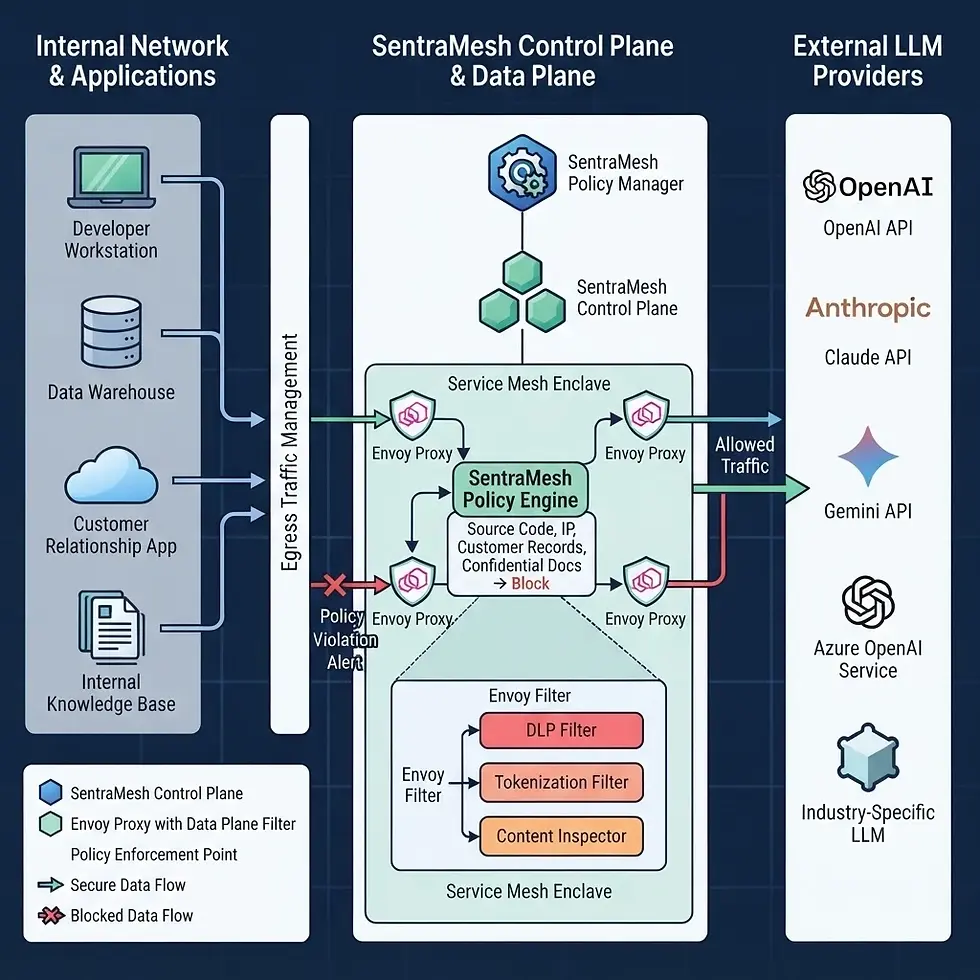
Many organisations are now integrating with OpenAI, Anthropic, Gemini, Azure OpenAI, and industry-specific LLM platforms.
One of the biggest governance concerns is employees or applications accidentally sending sensitive information into foundation models.
A SentraMesh policy might state that source code, intellectual property, customer records, and confidential documents may not be submitted to public LLM endpoints.
Depending on policy, SentraMesh may allow the request, redact sensitive fields, tokenise customer data, route traffic to an approved private model, or block the request entirely.
This creates a practical AI governance mechanism directly in the runtime environment.
Real-World Example 3: Controlling Cross-Border Data Movement

Many organisations must comply with GDPR, UK GDPR, data residency laws, and industry-specific regulations.
A policy might specify that European citizen data must remain within approved EU jurisdictions. When an application attempts to access a service endpoint located outside approved regions, Envoy can identify the source workload, data classification, destination geography, and regulatory metadata.
Enforcement options include allowing the transfer, redirecting to a regional service, requiring encryption, requiring additional approval, or blocking the transfer.
Instead of relying on developers to remember residency requirements, compliance becomes automated.
Real-World Example 4: Zero Trust Data Access

Most Zero Trust implementations focus on users and networks. Modern enterprises need Zero Trust principles applied to data itself.
A SentraMesh policy can define access by data classification:
Public data is broadly allowed, Internal data requires authenticated users, Confidential data requires MFA, and Restricted data is limited to approved workload identities.
An Envoy ExtAuthz filter can evaluate user identity, device posture, service account, location, and risk score before allowing access to a protected dataset.
The decision is made on every transaction, not just during login.
Real-World Example 5: Detecting Shadow AI and Unauthorised Services

One emerging challenge is shadow AI adoption. Employees and applications increasingly connect to unapproved AI services, data enrichment platforms, external analytics APIs, and file sharing systems.
Using Envoy domain inspection and traffic detection, SentraMesh can identify requests destined for known AI providers, unapproved SaaS platforms, and unsanctioned APIs.
If a request matches a prohibited category, it can be blocked, redirected, logged, or sent for approval. The organisation gains visibility into AI consumption before it becomes a compliance issue.
How SentraMesh Extends Envoy
Envoy is an exceptional enforcement engine, but enterprises rarely want to manage thousands of individual filter configurations.
SentraMesh provides centralised policy definition, policy distribution, consistent governance enforcement, multi-cluster policy propagation, audit and compliance reporting, and runtime policy evaluation.
The governance model becomes: Enterprise Policy → SentraMesh → Policy Distribution → Envoy Filters → Runtime Enforcement.
Instead of hand-coding governance logic into applications, enterprises define intent once and allow SentraMesh to ensure consistent enforcement everywhere data flows.
The Future of Data Governance is Runtime Governance
The rise of AI agents, multi-cloud architectures, distributed APIs, and autonomous workloads is exposing the limits of traditional governance approaches.
Policies that exist only in documents, catalogues, or governance committees cannot react at machine speed.
By combining SentraMesh policy intelligence with Envoy's extensible filtering architecture, organisations can move governance into the data plane itself.
The result is governance that is observable, automated, auditable, distributed, and enforceable.
Because in an AI-driven enterprise, the real question is no longer whether you've defined a policy. It's whether you can enforce it at the exact moment data moves.

Comments