How Envoy and sentramesh Create a Governance Control Plane for Agentic AI

Agentic AI changes the risk model because it does more than answer questions. It can act, delegate, call tools, read data, write data, and chain decisions across systems. That creates a hard problem for security leaders: the most important control point is no longer just the API endpoint. It is the moment an agent decides what action to take.
Traditional gateways, identity systems, and logging tools were built for predictable request and response patterns. They can authenticate a caller. They can route traffic. They can inspect some headers. But agentic workflows often place intent inside message bodies, prompts, tool calls, and multi-step execution plans.
That means a request can look safe at the network layer while carrying a risky instruction inside the payload.
For CISOs, the governance question is direct: can the enterprise observe, control, and prove what agents are doing in real time?
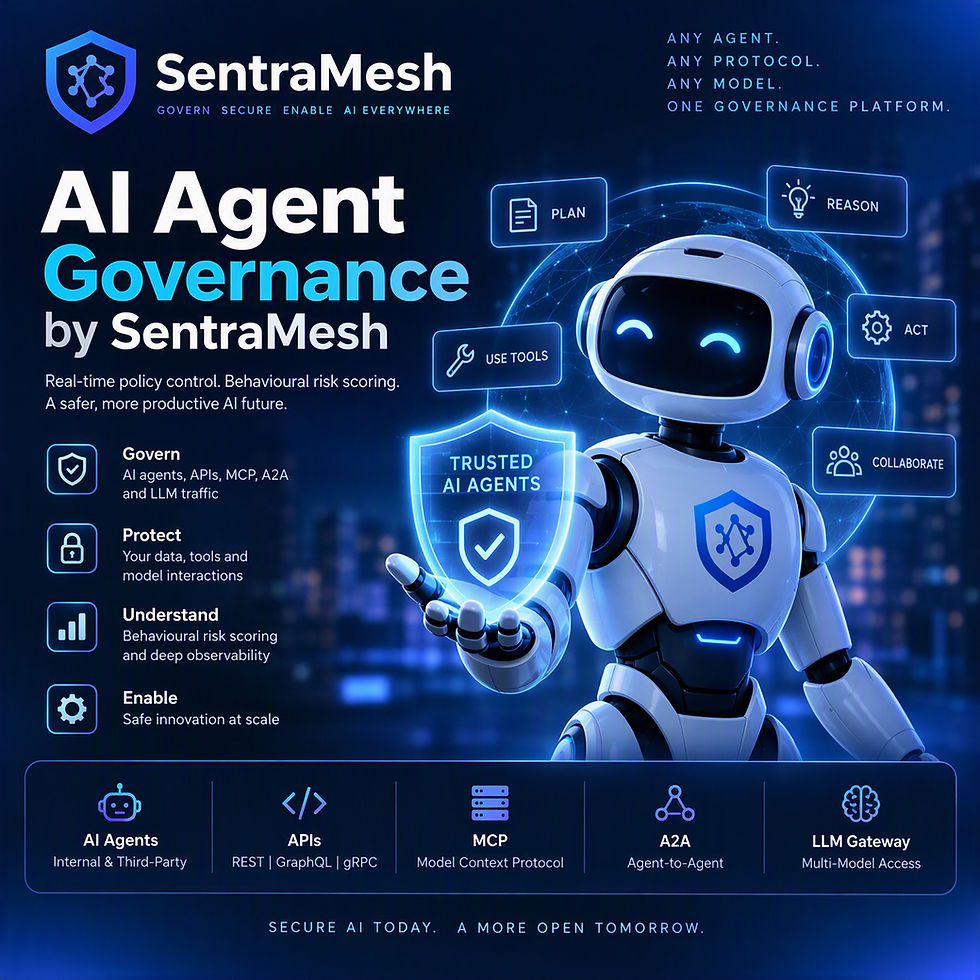
Envoy and sentramesh provide a practical answer. Envoy acts as the protocol-aware enforcement layer. sentramesh acts as the enterprise governance and audit layer. Together, they create a control plane for agentic AI that supports policy enforcement, exposure reduction, and defensible assurance.

Agentic AI creates risk that legacy controls cannot fully see
Agentic systems behave differently from conventional applications. A standard application follows code paths that engineers define in advance. An agent may interpret a goal, choose a tool, call another agent, access a data source, and produce an output based on changing context.
That flexibility creates value, but it also creates new exposure.
Common AI risks include:
Agents acting with delegated human authority
Tool calls that change records, transactions, permissions, or configurations
Sensitive data flowing into prompts, model calls, or external services
Multi-agent chains that bypass known policy points
Weak audit trails that show the API call but not the reason behind it
Long-running workflows where one approved action leads to unapproved follow-on activity
This is why agent governance cannot rely only on perimeter checks. The enterprise needs control at the level of intent, context, identity, tool use, and data domain.
A CISO also needs evidence. If a regulator, auditor, board committee, or customer asks what an AI agent did, the answer cannot be a loose collection of logs from different systems. It must be clear, traceable, and tied to policy.
Envoy becomes the enforcement point agents cannot bypass
Envoy is well suited to sit in the path of agent traffic because it already handles high-volume service communication, identity-aware routing, policy hooks, and protocol-level control. In an agentic AI environment, its role expands from traffic management to real-time enforcement.
Envoy can inspect and mediate traffic between:
Agents and tools
Agents and models
Agents and data services
Agents and other agents
Agent runtimes and enterprise APIs
That position matters. Policies become far more useful when they are enforced at the exact moment an action is attempted.
For example, an agent may attempt to retrieve customer records, summarize them through a model, and then update a case management system. A standard gateway may see a series of API calls. Envoy, paired with sentramesh, can treat those calls as governed actions within a broader agent workflow.
This enables controls such as:
Allowing or denying a tool invocation
Requiring human approval for sensitive actions
Limiting access to specific data domains
Redacting or blocking sensitive content before model calls
Enforcing workload identity instead of embedded credentials
Capturing decision context for audit
The key is that the agent does not become the trusted control point. Envoy enforces policy outside the agent, where the enterprise can manage it consistently.
sentramesh turns enforcement into governance
Envoy can enforce, but enforcement alone is not enough. CISOs also need a governance layer that defines policy, evaluates context, records decisions, and produces evidence.
That is where sentramesh fits.
sentramesh provides the governance and audit layer that tells Envoy what to allow, deny, restrict, or escalate. It can evaluate agent behavior against enterprise policy and create a record of what happened, why it was allowed, and which controls applied.
This distinction matters:
Envoy sits inline and enforces controls at runtime.
Envoy controls traffic between agents, tools, models, and APIs.
Envoy prevents agents from becoming unmanaged paths into enterprise systems.
sentramesh defines, evaluates, and records governance decisions.
sentramesh maps actions to policy, risk, approvals, and evidence.
sentramesh helps prove the organization has active oversight.
For security leadership, this pairing turns AI governance from a policy document into an operating control.
A written AI policy may say agents cannot access regulated data without approval. Envoy and sentramesh make that policy enforceable. The agent attempts the action, sentramesh evaluates the policy, Envoy enforces the decision, and the event becomes part of an audit trail.
That is the foundation of defensible agentic AI.
Zero trust for agents reduces credential sprawl
One of the most dangerous shortcuts in AI deployment is giving agents long-lived credentials. It may seem convenient during early builds, but it creates a serious control problem.
If an agent holds credentials, the agent becomes a privileged security principal. If the agent is misused, manipulated, or compromised, those credentials can be abused. The risk grows when agents call multiple tools or operate across business domains.
A zero-trust model for agents changes the pattern.
Agents should not carry standing access to sensitive systems. Instead, Envoy can inject credentials dynamically based on sentramesh policy decisions. Access becomes conditional, time-bound, and tied to context.
That model supports several security goals:
No standing privilege inside the agent
No hardcoded secrets in prompts, tools, or runtime code
No broad access because an agent might need it later
No trust based only on the user who launched the workflow
Access decisions can account for the agent, the user, the requested tool, the data domain, the purpose, and the sensitivity of the action. If the context changes, the authorization decision can change with it.
This is especially important when agents operate under delegated human authority. A user may have access to a system, but that does not mean every agent acting on that user’s behalf should have the same reach. The control plane must separate human entitlement from agent permission.
Inline policy enforcement makes AI controls real
Many AI governance programs start with acceptable use rules, model approval processes, and review boards. Those are useful, but they do not stop a live agent from taking a risky action at runtime.
Inline enforcement closes that gap.
When Envoy and sentramesh sit in the flow, policy can be applied at the moment of action. That allows security teams to define controls for specific AI behaviors, not just broad system categories.
Examples include:
Blocking an agent from sending protected data to an unapproved model
Requiring human approval before an agent updates financial records
Allowing read-only access for one workflow while denying write actions
Preventing one agent from invoking another agent outside an approved chain
Restricting tool use based on business unit, geography, or data class
Stopping prompt content that contains secrets before it reaches a model
The distinction is important. A model call is not just a network event. A tool invocation is not just an API request. In an agentic system, both can represent business actions with legal, financial, operational, or privacy impact.
Inline policy enforcement helps CISOs align AI behavior with enterprise obligations. It also reduces reliance on after-the-fact detection, where the damage may already be done.

Auditability becomes a first-class control
A weak audit trail is one of the largest assurance gaps in agentic AI. Standard logs may show that a service called another service, but they often fail to show the intent, policy decision, delegated user, tool used, or approval status.
That is not enough for serious governance.
For AI systems that can act autonomously, audit records need to answer practical questions:
Which agent took the action?
Which user, process, or business purpose delegated the authority?
What tool or data source did the agent access?
What policy applied at the time?
Was the action allowed, denied, or escalated?
Was sensitive data exposed to a model or external service?
Did a human approve the action?
What was the result?
sentramesh can provide this governance record while Envoy enforces the decision in the traffic path. Together, they create a more complete account of agent behavior.
That record matters for more than compliance. It supports incident response, internal investigations, customer assurance, model risk management, and board reporting. It also helps security teams identify policy gaps before they become systemic failures.
When a CISO briefs leadership, the message should be grounded in evidence: what agents are permitted to do, what they have done, what was blocked, and where human approval was required.
Data protection needs to cover prompts, tools, and model calls
Agentic AI changes where sensitive data can appear. Data may exist in a database, but it can also appear in prompts, intermediate reasoning steps, tool outputs, memory stores, embeddings, summaries, and model responses.
That makes data governance harder.
A traditional data loss prevention tool may identify a file transfer or an email attachment. It may not understand that an agent has pulled customer data into a prompt and is about to send it to a model outside the approved boundary.
Envoy and sentramesh can help enforce data-domain controls at runtime. For example, policies can prevent regulated data from flowing to unapproved destinations, restrict which tools can process certain classes of data, or require approval before a summary leaves a protected environment.
This supports core CISO priorities:
Reducing sensitive data exposure
Keeping AI workflows within approved trust boundaries
Enforcing purpose-based access
Preserving evidence of policy decisions
Separating permitted use from unsafe reuse
The policy should follow the data, not just the application. If an agent moves sensitive information from one context to another, governance must move with it.
Multi-agent workflows need a shared control plane
Single-agent risk is only the starting point. Many enterprise AI systems will use multiple agents that divide work, call specialized tools, and hand off tasks. That can produce useful automation, but it also creates hidden paths through the enterprise.
One agent may appear low risk because it only summarizes information. Another may appear low risk because it only schedules tasks. A third may have write access to production data. When these agents interact, the combined workflow can create higher risk than any single component suggests.
A governance control plane helps security teams manage the chain rather than isolated pieces.
It can define whether one agent is allowed to call another, which tools are permitted in a workflow, and when a handoff changes the risk level. It can also help stop policy bypass, where an agent uses another agent to perform an action it could not perform directly.
This is critical for containment. Agentic systems need boundaries that persist across delegation. Without shared governance, multi-agent workflows can become blind spots.
The CISO value is defensibility
The strongest case for Envoy and sentramesh is not technical elegance. It is defensibility.
A CISO must be able to explain how the organization governs agentic AI. That explanation needs to hold up under board scrutiny, regulatory review, customer due diligence, and incident response.
A defensible program can show:
Agents do not hold unmanaged credentials
Sensitive actions are governed at runtime
Policies are enforced inline, not only documented
Data boundaries apply to prompts, tools, and model calls
Human approval is required when risk calls for it
Multi-agent workflows are controlled
Audit records show what happened and why
This creates a cleaner risk story. The organization is not trusting agents to behave. It is placing enforceable controls around agent behavior.
That changes the AI governance conversation from aspiration to assurance.
What good implementation should prioritize
A governance control plane for agentic AI should start with the highest-risk use cases. The first targets are usually workflows that combine autonomous action, sensitive data, and system mutation.
Security teams should focus on:
Credential removal
Remove standing secrets from agents and shift to dynamic credential injection based on policy.
Tool control
Classify tools by risk and enforce which agents can use them, under which conditions.
Data-domain boundaries
Define where sensitive data can flow and block unsafe model or tool destinations.
Human approval
Require approval for high-impact actions such as payments, privilege changes, regulated data movement, or record modification.
Audit completeness
Capture agent identity, delegated authority, policy decision, tool use, data class, and outcome.
Workflow containment
Govern agent-to-agent delegation so that indirect paths cannot bypass policy.
This sequencing keeps the program tied to exposure reduction. It also gives leadership a clear view of progress: fewer unmanaged credentials, fewer ungoverned tool calls, better audit coverage, and tighter control around sensitive data.
Agentic AI needs controls built for action
Agentic AI is not just another application layer. It is a new operating pattern where software can interpret goals and act across enterprise systems. That calls for governance that can operate at the same speed as the agent.
Envoy and sentramesh create that governance control plane by combining inline enforcement with enterprise policy and audit. Envoy sits where action happens. sentramesh decides and records whether that action fits policy.
The result is a practical model for agentic AI governance: observe behavior, control execution, reduce exposure, and prove compliance with evidence.
For CISOs, that is the point. Safe adoption does not come from hoping agents make the right choices. It comes from building a control plane that makes the right choices enforceable.

Comments